What ginkgo leaf extract is, how to read an extract ratio such as 4:1, what the US National Center for Complementary and Integrative Health says about its safety, and how much is in a VapoCept capsule.

Editorial disclosure: vapoceptguide.com is an independent guide and is not the manufacturer, distributor or seller of VapoCept. It contains affiliate links, and we may earn a commission if you purchase through them, at no extra cost to you. These statements have not been evaluated by the Food and Drug Administration. VapoCept is not intended to diagnose, treat, cure, or prevent any disease. Consult a healthcare professional before use.
Ginkgo biloba is a deciduous tree that the US National Center for Complementary and Integrative Health (NCCIH) describes as a "living fossil". Its fan-shaped leaves are dried and extracted, and NCCIH notes that the leaf, usually as an extract, is the most commonly used form of ginkgo. When a supplement label says "Ginkgo (Ginkgo biloba) (Leaf) Extract", it means that leaf extract.
Ginkgo, ginkgo biloba, maidenhair tree. On supplement labels the Latin name usually follows the common one, with the plant part in brackets.
The leaf. NCCIH's safety notes for supplements concern leaf extracts, the form found in capsules such as VapoCept.
As capsules and tablets on its own, and as one ingredient in multi-ingredient formulas. VapoCept is one of the second kind.
Ginkgo labels describe their extract in one of two ways, sometimes both. An extract ratio such as 4:1 says how much dried leaf went into one part of extract: about four parts of leaf for every part of finished extract. A standardization names compounds and their share of the extract, for example a percentage of flavone glycosides. The two answer different questions: the ratio describes concentration, the standardization describes content.
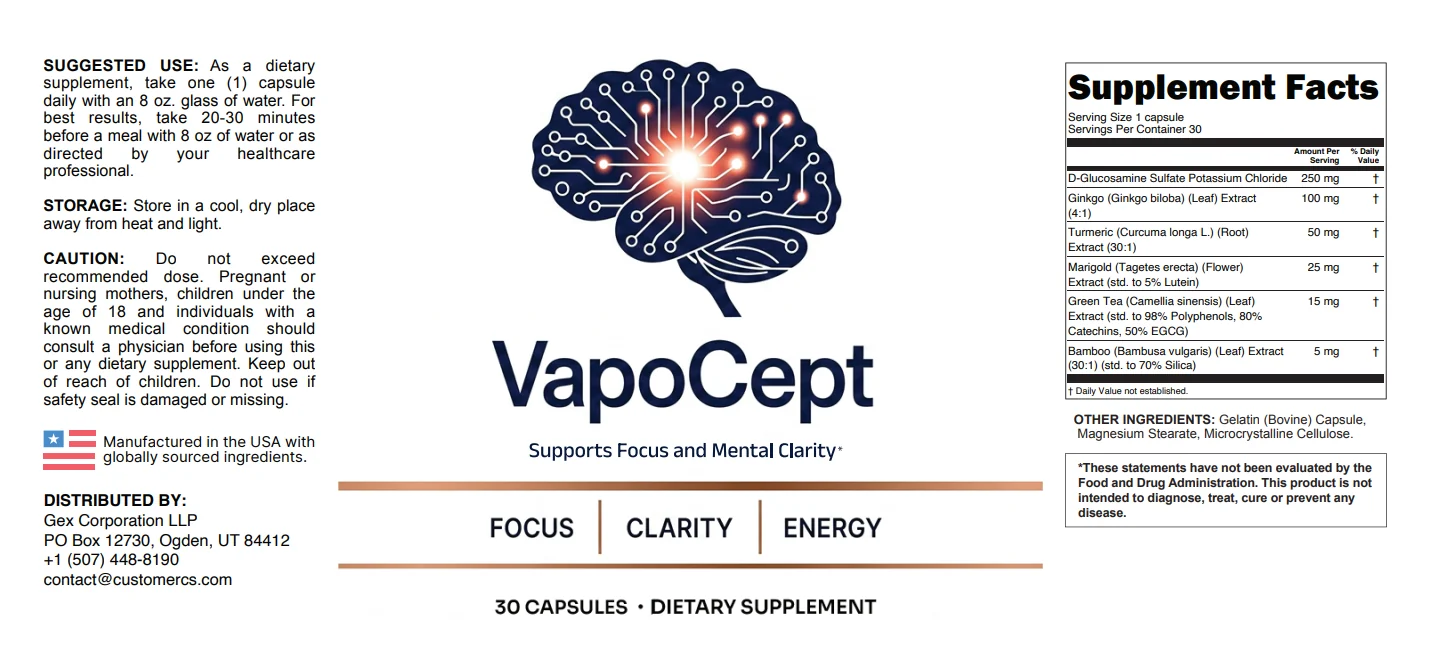
"Ginkgo (Ginkgo biloba) (Leaf) Extract (4:1)", 100 mg per capsule. The label gives the ratio and lists no standardization percentage for the ginkgo, so the 100 mg is the weight of the extract itself.
At 100 mg, ginkgo is the second-largest of the six VapoCept ingredients, after glucosamine at 250 mg. The full panel is on the VapoCept ingredients page.
If you take any medicine, NCCIH's advice is to talk with your health care provider before using ginkgo or other herbal products. Check with a doctor first.
An extract of the dried leaves of the ginkgo tree, Ginkgo biloba. NCCIH notes that the leaf extract is the most commonly used form of ginkgo.
About four parts of dried leaf were used for each part of extract. It describes concentration; it is not a standardization of any compound.
NCCIH says that for most adults, ginkgo leaf extracts are likely to be safe when taken by mouth in moderate amounts, and that the extract is generally well tolerated. Talk with a health care provider first if you take any medicine.
Ask your doctor first. NCCIH says ginkgo may interact with blood-thinning medicines such as warfarin.
NCCIH says ginkgo may be unsafe during pregnancy, and little is known about its use while breastfeeding.
100 mg of ginkgo leaf extract 4:1 per capsule, the second-largest amount on the label. See the VapoCept ingredients page.
VapoCept combines 100 mg of ginkgo leaf extract with glucosamine, turmeric, marigold, green tea and bamboo in one daily capsule. The packs, the guarantee and how to order are in the VapoCept buying guide.
Go to the VapoCept Order PageThis site uses Google Analytics cookies to count visits. See the privacy policy.