What is actually inside a VapoCept capsule: the Supplement Facts panel transcribed, what the ratios and standardizations mean, the capsule's other ingredients, and one public source for each active ingredient.

Editorial disclosure: vapoceptguide.com is an independent guide and is not the manufacturer, distributor or seller of VapoCept. It contains affiliate links, and we may earn a commission if you purchase through them, at no extra cost to you. These statements have not been evaluated by the Food and Drug Administration. VapoCept is not intended to diagnose, treat, cure, or prevent any disease. Consult a healthcare professional before use.
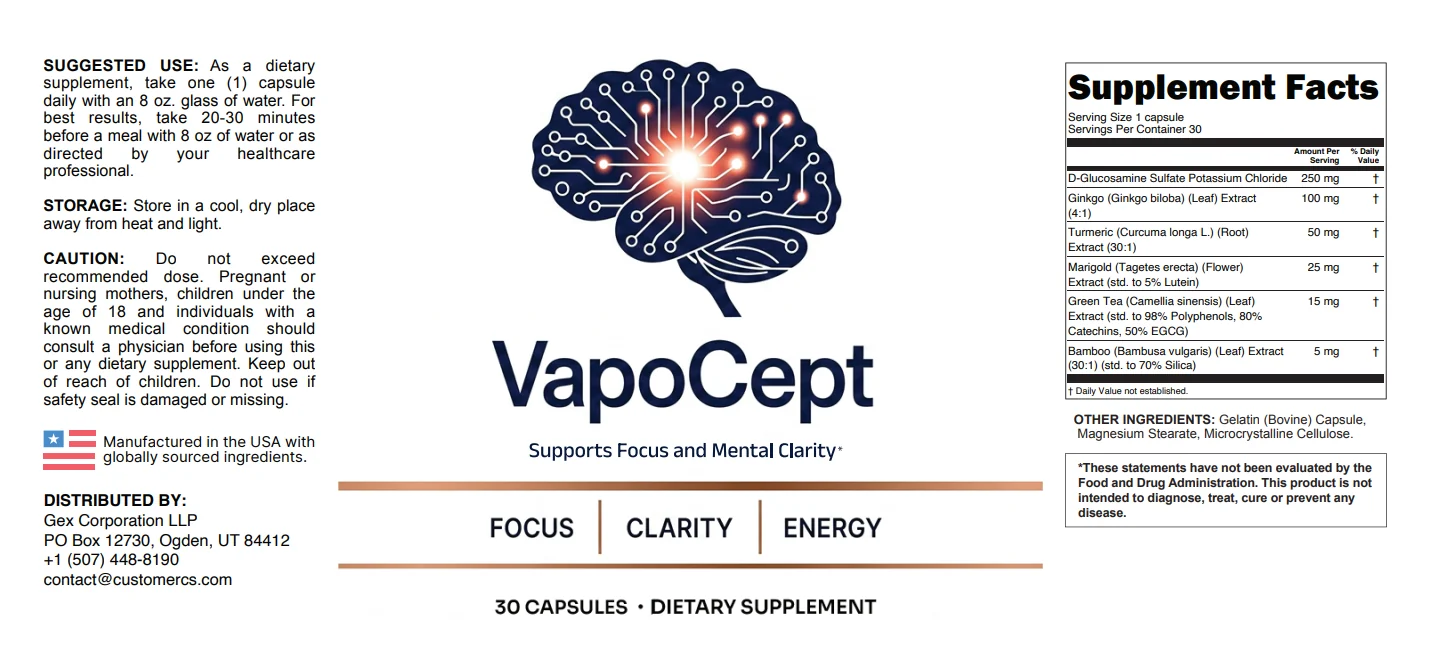
The VapoCept ingredients list below is transcribed from the label image on the official order page, uploaded in September 2026. One capsule is one serving, and every active ingredient has its own amount. Click any picture to see it full size.
| Serving size | 1 capsule |
|---|---|
| Servings per container | 30 |
| D-Glucosamine Sulfate Potassium Chloride | 250 mg |
| Ginkgo (Ginkgo biloba) (Leaf) Extract (4:1) | 100 mg |
| Turmeric (Curcuma longa L.) (Root) Extract (30:1) | 50 mg |
| Marigold (Tagetes erecta) (Flower) Extract (std. to 5% Lutein) | 25 mg |
| Green Tea (Camellia sinensis) (Leaf) Extract (std. to 98% Polyphenols, 80% Catechins, 50% EGCG) | 15 mg |
| Bamboo (Bambusa vulgaris) (Leaf) Extract (30:1) (std. to 70% Silica) | 5 mg |
| % Daily Value | Daily Value not established for any of the six |
| Other ingredients | Gelatin (Bovine) Capsule, Magnesium Stearate, Microcrystalline Cellulose |
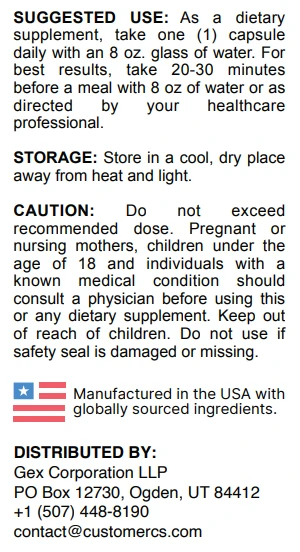
| Suggested use | "As a dietary supplement, take one (1) capsule daily with an 8 oz. glass of water. For best results, take 20-30 minutes before a meal with 8 oz of water or as directed by your healthcare professional." |
| Storage | "Store in a cool, dry place away from heat and light." |
| Caution | "Do not exceed recommended dose. Pregnant or nursing mothers, children under the age of 18 and individuals with a known medical condition should consult a physician before using this or any dietary supplement. Keep out of reach of children. Do not use if safety seal is damaged or missing." |
| Origin | "Manufactured in the USA with globally sourced ingredients." |
| Distributed by | Gex Corporation LLP, PO Box 12730, Ogden, UT 84412 · +1 (507) 448-8190 · contact@customercs.com |
The six actives add up to 445 mg: glucosamine 250 mg, ginkgo 100 mg, turmeric 50 mg, marigold 25 mg, green tea 15 mg and bamboo 5 mg. A dagger next to each amount means a Daily Value has not been established for that ingredient.
An extract ratio tells you how much dried plant went into one part of extract. "4:1" for the ginkgo means about four parts of leaf per part of extract; "30:1" for the turmeric root and the bamboo leaf means about thirty. The ratio describes concentration, not a dose.
A standardization names a compound and its share of the extract. The marigold is standardized to 5% lutein (about 1.25 mg in 25 mg), the green tea to 98% polyphenols, 80% catechins and 50% EGCG (about 7.5 mg of EGCG in 15 mg), and the bamboo to 70% silica (about 3.5 mg in 5 mg).
Glucosamine is an amino sugar and a natural component of cartilage. The form on this label is glucosamine sulfate combined with potassium chloride, a form that has its own monograph in the United States Pharmacopeia–National Formulary. The NIH LiverTox database notes that glucosamine in supplements is usually prepared from the shells of shellfish or by fermentation of grain. The VapoCept label does not say which. Full notes: glucosamine sulfate potassium chloride.
NIH LiverTox: GlucosamineNCCIH describes ginkgo as a tree considered a "living fossil" and says the leaf, usually as an extract, is the most commonly used form. The label gives the extract ratio, 4:1, and does not list a standardization percentage for this extract. Full notes: ginkgo biloba leaf extract.
NCCIH: GinkgoTurmeric is a plant in the ginger family grown commercially in Southeast Asia and India. NCCIH explains that its health activities are commonly attributed to curcuminoids, including curcumin, the compound that gives the spice its yellow color. The label gives a 30:1 ratio for the root extract.
NCCIH: TurmericLutein is a yellow carotenoid. A 2023 study of ten marigold cultivars in Foods describes marigold flower petals as the primary source of lutein for commercial extraction, and notes that lutein and zeaxanthin occur as a pigment in the macula of the retina. Full notes: marigold flower extract and lutein.
Foods, 2023 (PMC)Green tea is made from leaves that are steamed, pan-fried and dried but not fermented, as NCCIH describes. The extract here is standardized to 98% polyphenols, 80% catechins and 50% EGCG. Caffeine is not listed on the panel, and the label does not say whether the extract is decaffeinated.
NCCIH: Green teaSilica is silicon dioxide, the form in which silicon occurs in many plants. A 2007 review of silicon and bone health describes plant-derived foods, unrefined grains and drinking water as the main dietary sources, with typical intakes of 20 to 50 mg of silicon a day in Western populations.
Silicon review, 2007 (PMC)Some web pages and press releases describe VapoCept with an amino-acid formula: L-arginine, L-citrulline, beta-alanine, niacin and calcium. The label now shown on the official order page lists the six ingredients on this page. This guide follows that label; the bottle you receive is the final word.
Per capsule: D-glucosamine sulfate potassium chloride 250 mg, ginkgo leaf extract 4:1 100 mg, turmeric root extract 30:1 50 mg, marigold flower extract (5% lutein) 25 mg, green tea leaf extract (98% polyphenols, 80% catechins, 50% EGCG) 15 mg and bamboo leaf extract 30:1 (70% silica) 5 mg. Other ingredients: gelatin (bovine) capsule, magnesium stearate and microcrystalline cellulose.
The six active ingredients add up to 445 mg per capsule. The capsule shell and the two capsule-filling ingredients come on top of that; the label does not give their weight.
No. Every active ingredient is printed with its own amount.
Caffeine is not listed on the Supplement Facts panel. The green tea extract is standardized to polyphenols, catechins and EGCG; the label does not say whether it is decaffeinated.
No. The label lists a gelatin (bovine) capsule.
The label does not say. NIH LiverTox notes that supplement glucosamine is usually prepared from shellfish shells or by fermentation of grain. If you avoid shellfish, ask support at contact@customercs.com before ordering.
Some pages and press releases describe an amino-acid formula with L-arginine and L-citrulline. The label image on the official order page, uploaded in September 2026, lists glucosamine, ginkgo, turmeric, marigold, green tea and bamboo. Follow the label on your bottle.
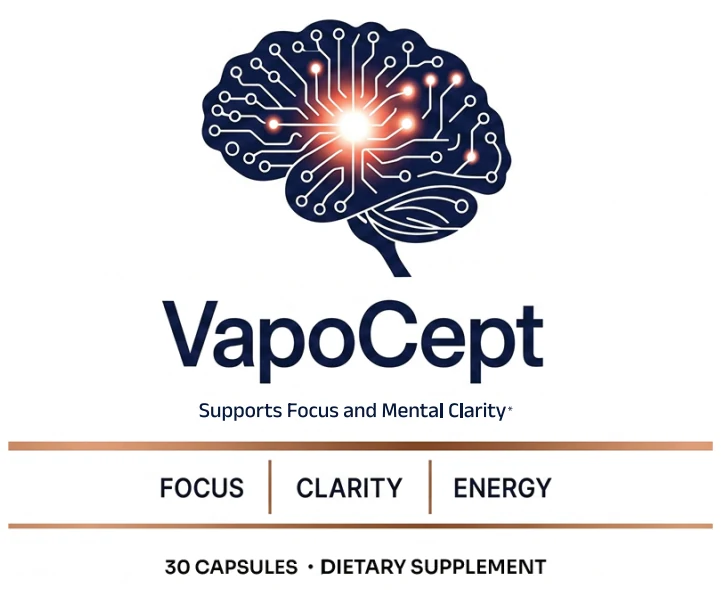
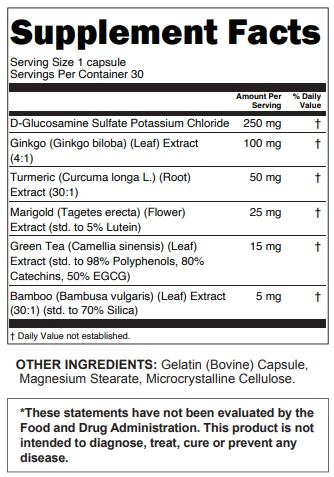
The official order page shows the full label as one image; this page reproduces it with crops of the front, the Supplement Facts and the directions. The official order page is the place to check for changes.
VapoCept comes in packs of 2, 3 or 6 bottles of 30 capsules. The 3- and 6-bottle packs ship free, and the order page states a 60-day money-back guarantee. Step-by-step help is in the VapoCept buying guide.
Go to the VapoCept Order PageThis site uses Google Analytics cookies to count visits. See the privacy policy.